Holley STUDIO

Work

Selected work, honestly labeled.

Filter by proof type. Holley Studio does not currently list external Studio client case studies here—what you see is prior professional work, products, internal systems, and demos, each tagged so the origin is clear.

Prior work / referenceInternal dogfood systemLive in production
Prior Work · Enterprise AI PlatformPrior professional work

AI Creative Operations Platform

Prior professional work — regional creative agency, 50+ employees (built before Holley Studio was founded)

Role: Lead engineer / systems builder · Status: Prior professional — completed
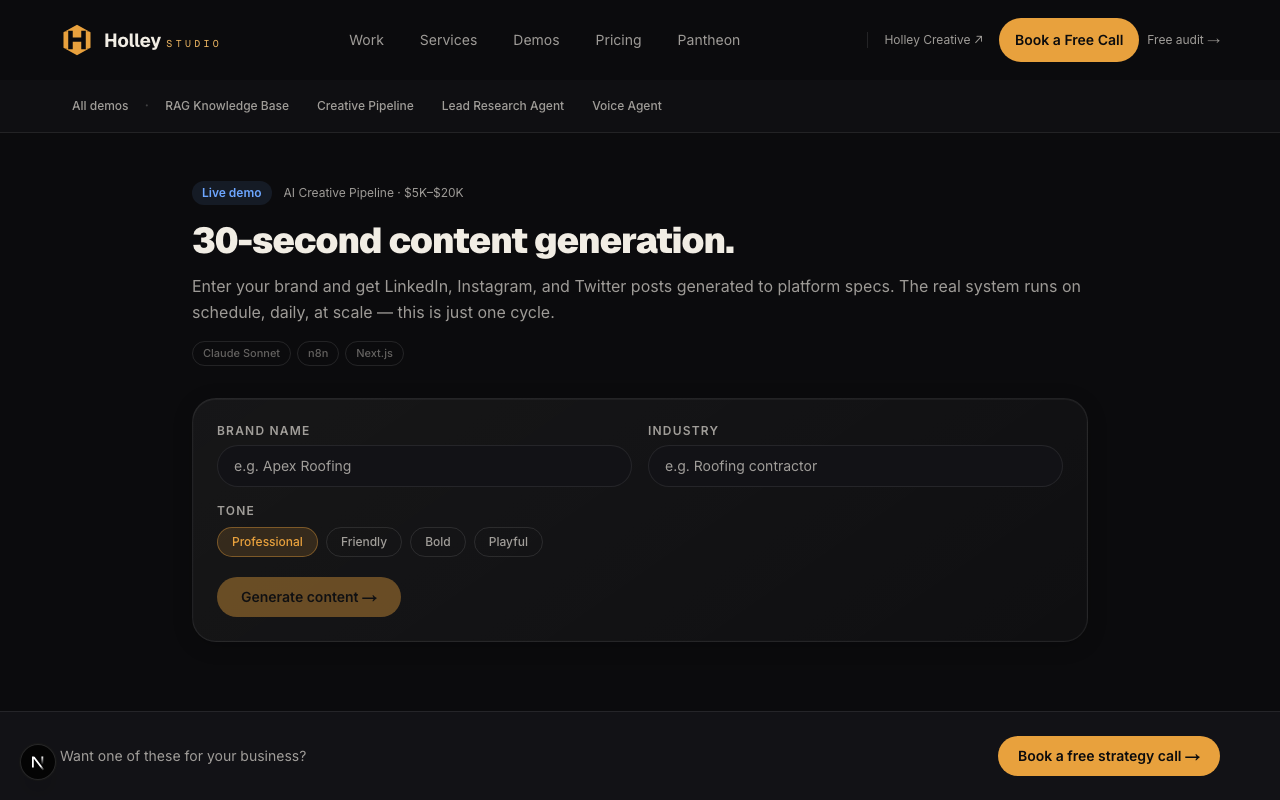
AI Creative Pipeline demo — brand and industry inputs generating LinkedIn, Instagram, and Twitter posts on the Holley Studio live demo.
Live demo of the same content-generation pattern used to build the original platform — try it at /demos/creative-pipeline.

Context

Enterprise creative-ops tooling built in a prior professional role — not a Holley Studio client engagement.

The Problem

A high-volume creative agency was producing 40+ campaigns per month. Brand voice consistency was inconsistent across writers. Knowledge about past campaigns was siloed in individual brains. Content repurposing took 2–3 hours per piece.

Stack

  • Next.js 14 (App Router)
  • OpenAI GPT-4o-mini
  • Custom RAG knowledge base (pgvector)
  • n8n workflow orchestration
  • Custom agent orchestration system
  • Supabase + Vercel Blob

What Was Built

  • Custom RAG knowledge base indexing brand voice, messaging pillars, and past campaign learnings
  • 14-tool AI platform: campaign builder, newsletter generator, shot list builder, content repurposer, case study wizard, media intelligence analyzer, and more
  • Agent orchestration system with 14 skill modules for multi-step campaign creation
  • monday.com integration for creative request intake → automated brief generation
  • Governance system with thousands of enforced security and quality rules across dozens of modules
  • Playwright e2e tests + CI/CD pipeline with release gate validation

Outcomes

Content repurposing: 2–3 hrs → under 10 min per piece in team measurement (labeled prior-professional outcome)
Brand-voice validation against indexed pillars before delivery — reduced ad-hoc rewrite loops
Campaign knowledge retrieval: email/Slack threads → seconds-scale search across indexed past work
Platform shipped to v7.6.0 and used in daily production at that employer

Evidence: Live pattern demo at /demos/creative-pipeline; narrative from prior role
Dogfood · Holley CreativeInternal Creative system

AI Photography Operations System

Holley Creative (holley-creative.com) — built for our own photography business

Role: Founder / builder · Status: Live — Holley Creative production

Lightroom exportJPEG, sRGBEXIF filterGPS stripped3× WebP derivatives400 / 1200 / 2400pxCloudflare R2CDN uploadSupabaseaudit trailPortfoliopublished

intake-batch --folder ~/exports --batch-key smith-wedding-2026

Context

Internal Holley Creative operations system — dogfooded daily.

The Problem

Managing shoots from Lightroom export to client delivery required 5+ manual tools: export preset, FTP upload, CDN URL copy-paste, Supabase insert, portfolio publish. No EXIF privacy protection, no structured intake record, no AI assistance, and no connection between uploaded files and database records after publish.

Stack

  • Next.js 16 (App Router)
  • Cloudflare R2 (CDN — 3 derivative sizes per image)
  • exiftool-vendored (EXIF filter + copyright injection)
  • sharp (WebP conversion at 400/1200/2400px)
  • blurhash (blur-up load placeholders)
  • Claude Haiku Vision (AI category + alt text at $0.05/100 images)
  • Supabase PostgreSQL (full intake audit trail)
  • n8n (batch-complete notification automation)
  • Zod 4 + cookie-based admin auth

What Was Built

  • CLI intake pipeline: Lightroom JPEG export → EXIF filter (GPS stripped, copyright injected) → 3 WebP derivatives → R2 → Supabase in one command
  • Three responsive derivatives per image at intake time: 400px (admin grid/mobile), 1200px (portfolio grid), 2400px (lightbox/hero) — generated in parallel
  • AI classification: Claude Vision suggests category and writes accessibility alt text per image, reviewed before applying
  • Admin review grid: blurhash blur-up placeholders, optimistic approve/reject UI, AI suggestions displayed inline
  • Publish flow: approved assets → portfolio item with srcset responsive images + junction table for full asset traceability
  • Full traceability: every image trackable from source SHA-256 hash → R2 key → published portfolio item
  • n8n batch-complete notification: email with review link fires when CLI finishes
  • Multi-service booking system: contact form, status pipeline, auto-reply, follow-up sequences

Outcomes

Lightroom export → published portfolio: ~45 min manual process → under 5 min automated CLI (internal timing)
GPS and camera serial stripped from every image before upload — no manual scrubbing step
Copyright embedded in every WebP derivative at the file level
Portfolio grid serves sized derivatives with srcset instead of a single full-resolution JPEG per cell

Evidence: Running on holley-creative.com intake/admin flows

Internal Tool · Live NowInternal Studio system

AI Readiness Lead Scoring Funnel

Holley Studio — internal tool, live at holley.studio/audit

Role: Founder / product builder · Status: Live at holley.studio/audit

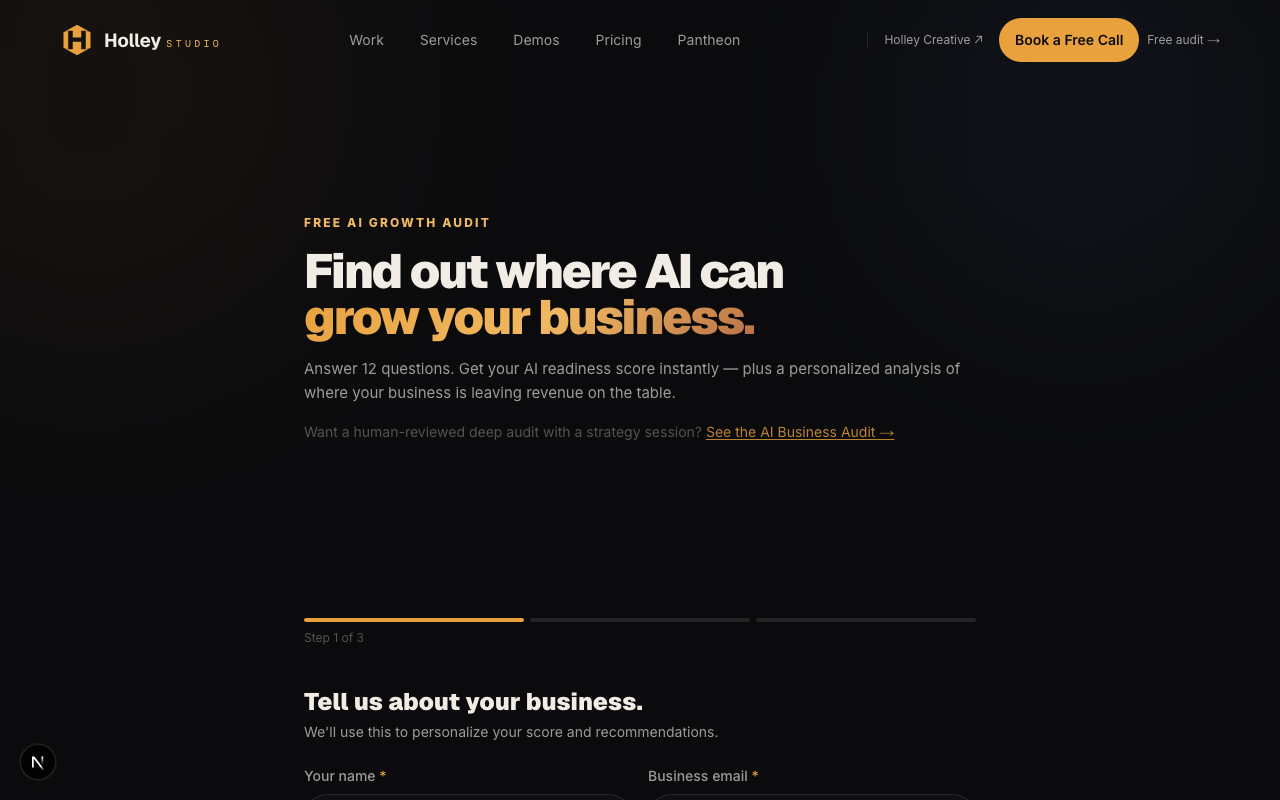
The live AI Growth Audit funnel at holley.studio/audit — step 1 of the 4-step qualification form.
The actual funnel, live now at holley.studio/audit.

Context

Internal Studio lead-qualification system — not a client case study.

The Problem

Most leads from a website contact form are unqualified — wrong budget, wrong timeline, wrong fit. We needed a way to automatically qualify prospects and route them to the right service tier before a first call.

Stack

  • Next.js 16 (App Router)
  • Claude claude-haiku-4-5-20251001 (personalized findings)
  • Supabase (audit_requests table)
  • n8n (score-tiered email sequences)
  • Zod (form validation)
  • React Hook Form

What Was Built

  • 4-step multi-screen audit form capturing 10 data points about business maturity
  • Deterministic scoring algorithm (0–100) weighted by revenue, team size, tools, and AI experience
  • 4 service tiers mapped to score ranges: Starting Line → Getting Started → Building Momentum → AI-Ready
  • Claude-generated personalized findings — 3 specific gaps with estimated costs and recommended services
  • n8n automation: score-tiered follow-up email sequence based on which tier the prospect lands in
  • Supabase storage of all audit submissions for CRM-lite pipeline management

Outcomes

Prospects self-score before booking — discovery calls start with a shared readiness context
Tier + gap summary arrives with the lead, shortening qualification on first call
Personalized findings (3 estimated cost gaps) keep the funnel from feeling like a generic quiz
Same pattern is reusable as a lead magnet for service businesses

Evidence: Public product surface at /audit

FSL-1.1-MIT · LiveOpen source

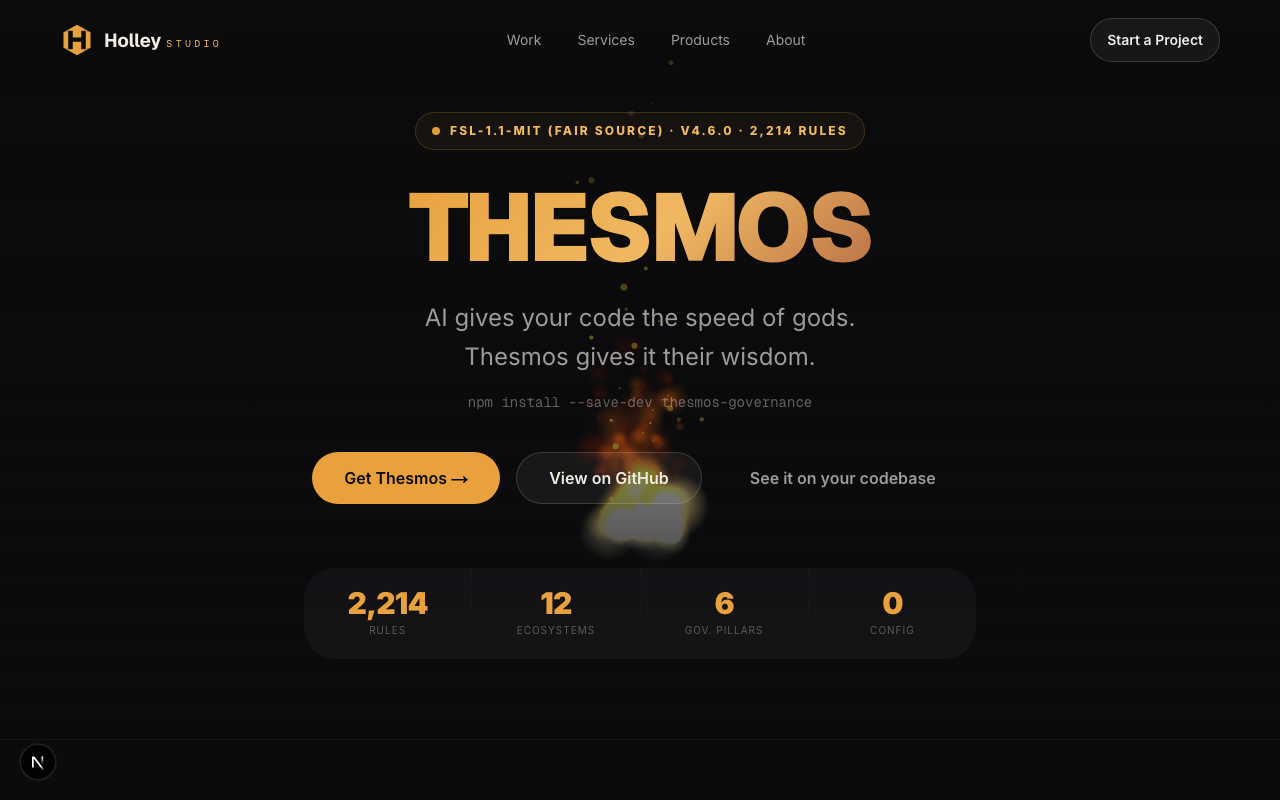
Thesmos — AI Code Governance System

Holley Studio — built for internal use, released under FSL-1.1-MIT (fair source) for the community

Role: Founder / product builder · Status: Live product · FSL-1.1-MIT fair source

The Thesmos landing page inside the Pantheon — rule engine, ecosystems, and governance pillars.
The Pantheon's live Thesmos page — thesmos-governance on npm.

Context

Studio product / open-source release — not a client engagement.

The Problem

AI coding tools (Claude, Cursor, Copilot) generate code fast but with repeating classes of security holes and anti-patterns — SSRF via fetch(userInput), admin clients in browser bundles, JWT decode without verify. Generic ESLint rules don't catch them. Teams had no systematic way to audit AI-generated code before it shipped.

Stack

  • TypeScript CLI (Node.js)
  • Rule engine across security, AI safety, auth, Next.js, React, and more
  • GitHub Actions integration
  • VS Code extension
  • npm package: thesmos-governance
  • Vercel (live scanner UI)

What Was Built

  • Governance engine covering security, AI safety, auth, Next.js, React, performance, database, and related categories
  • CLI scanner: runs locally or in CI — exits non-zero on BLOCKER findings
  • GitHub Actions gate: blocks PR merges when BLOCKER rules fire
  • VS Code extension: highlights violations inline as you type
  • npm package (thesmos-governance): install in any JavaScript/TypeScript project
  • Live web scanner — paste code, get findings instantly

Outcomes

BLOCKER-severity findings can be enforced in CI before merge
AI-specific rules target vulnerability patterns common in LLM-generated code
Released under FSL-1.1-MIT (fair source) — installable in JS/TS projects
Live scanner available for paste-and-scan demos

Evidence: npm package + live scanner UI

Engagements in Delivery

Active
Pilot slot open

AI Quick-Win Pilot

Anywhere in the US

$500 flat · ~1 week scoped pilot

Start an engagement →
Taking inquiries

Your business

Anywhere

Full project or ongoing retainer

Start an engagement →

Yours could be next.

Every one of these started with a 30-minute discovery call. We scope it, price it flat, and build it fast.